East Coast Freight Distribution

Freight That Doesn’t Fit the Standard Delivery Model
Not every delivery fits neatly into a standard freight schedule. Sometimes the freight is oversized or unusually heavy. Sometimes it needs to arrive within a very specific window. The destination might have difficult access, no loading dock or no forklift. Or a business may suddenly need something moved urgently that wasn’t part of the normal transport schedule.
At East Coast Freight Distribution, we call these non-standard freight requirements.
They are deliveries where simply allocating a truck and moving freight isn’t enough. The transport required additional planning around the freight, destination, timing and unloading requirements.
After more than 30 years in transport, I’ve learned that unusual freight isn’t necessarily difficult freight. You just need to understand the job before you try to solve it.
What Makes a Freight Delivery Non-Standard?
A standard freight movement generally works within established collection, transport and delivery processes. But there are plenty of situations where that model doesn’t quite work.
You may need a different transport solution if:
- Your freight is bulky, heavy or unusually shaped.
- You are moving large quantities of palletised goods.
- The delivery site has limited access.
- There is no loading dock or forklift at the destination.
- Freight needs to arrive during a narrow delivery window.
- You have an urgent or unexpected transport requirement.
- The delivery is part of a construction, commercial or event project.
- You need transport capacity for a short period rather than permanently.
- Several deliveries need to be coordinated as part of a larger project.
East Coast Freight Distribution already transports a diverse range of goods, including steel, cement, scaffolding, pallets, solar products, paint, turf and fruit.
The important question isn’t simply “Can this go on a truck?”
It is “What needs to happen for this delivery to work from beginning to end?”
Why Standard Freight Solutions Can Fall Short
Many transport problems occur because one part of the delivery has been considered without looking at the entire job. A truck may be able to carry the freight, for example, but what happens when it reaches the destination?
There might be:
- No suitable equipment to unload it.
- Restricted vehicle access.
- Limited space for manoeuvring.
- A strict site access time.
- Uneven or difficult ground conditions.
- No permanent loading infrastructure.
- Other contractors or deliveries competing for access.
This is particularly relevant for construction projects, temporary sites, regional properties and events. It is why we believe good freight planning starts with understanding what happens before, during and after transport.
How We Approach Non-Standard Deliveries
When we get an unusual transport requirement, we start by understanding the job.
Step 1: Understand the Freight
First, we need to know what we’re moving. That includes:
- Freight type
- Dimensions
- Weight
- Number of pallets or items
- Loading requirements
- Unloading requirements
- Any special handling considerations
These details help determine which vehicle and equipment are appropriate. Our fleet includes articulated, heavy-duty and medium-duty trucks with different trailer, tailgate and mobile forklift configurations.
Step 2: Look at the Collection and Destination
The next consideration is where the freight is coming from and where it needs to go. A warehouse-to-warehouse movement is very different from delivering to a temporary site. We may need to consider:
- Vehicle access
- Loading facilities
- Site restrictions
- Ground conditions
- Available unloading equipment
- Where the freight needs to be positioned
- Delivery times
- Site contacts
Knowing this before the truck leaves can prevent unnecessary delays at the other end.
Step 3: Match the Vehicle to the Job
Different freight requires different vehicles. East Coast Freight Distribution operates a diverse fleet that allows us to match transport capacity more closely to individual requirements. For example:
Delivery requirement | Possible transport approach |
General palletised freight | Curtain-side or suitable general freight vehicle |
Heavy or bulky freight | Heavy-duty truck or appropriate trailer configuration |
Oversized items | Flatbed or suitable specialised vehicle |
Site without unloading equipment | Truck with mobile forklift |
Weather-sensitive freight | Enclosed or suitable weather-protected vehicle |
Temperature-sensitive goods | Refrigerated transport |
Dedicated ongoing deliveries | Permanent truck and driver hire |
Unique or short-term requirements | Project logistics solution |
The appropriate vehicle will always depend on the specific freight, route and site conditions. You can read more about our fleet and our general freight capability.
Step 4: Plan How the Freight Will Be Unloaded
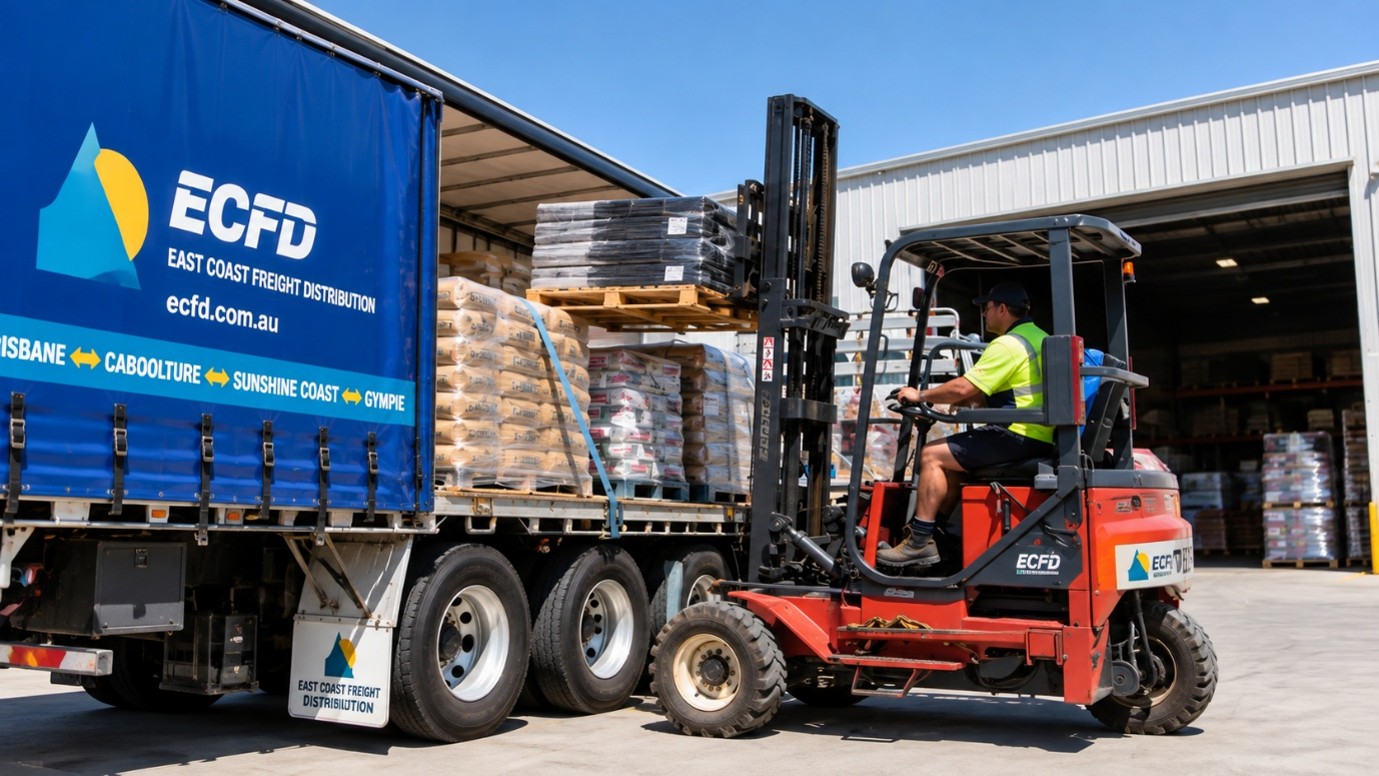
Getting the freight there is only part of the delivery. If the destination doesn’t have suitable unloading equipment, we need to know that beforehand. This is where our mobile forklift capability can be particularly useful.
Our mobile forklifts travel with suitable delivery vehicles, allowing us to unload palletised, heavy or awkward freight at destinations without their own forklift or loading dock.
It can remove the need to coordinate:
- Separate forklift hire
- Another equipment supplier
- Additional labour
- Multiple arrival times
Step 5: Work Around Timing Requirements
Not every delivery can arrive between 9 am and 5 pm whenever it suits the transport schedule.
Construction sites can have allocated access periods. Events have bump-in schedules. Commercial premises may restrict deliveries to certain times. An urgent order may need to move much sooner than usual.
Where possible, we look at the transport requirement and find a practical way to work within those constraints. Our project logistics service is specifically designed for requirements that fall outside normal transport arrangements, including short-term hourly work, specialised projects, dedicated transport and customised solutions.
Standard Freight vs a More Flexible Transport Solution
Standard delivery | Non-standard delivery |
Regular freight dimensions | Bulky, heavy or unusual freight |
Established delivery schedule | Specific or unusual delivery window |
Loading dock available | Limited or no loading infrastructure |
Forklift available on site | Mobile forklift may be required |
Straightforward site access | Restricted or challenging access |
Regular transport route | Project-specific transport |
Predictable freight volume | Sudden or changing transport demand |
Standard vehicle allocation | Vehicle selected around the job |
Neither approach is inherently better. The key is using the right transport model for the job.
Sometimes You Just Need More Capacity
A non-standard freight requirement doesn’t always involve unusual cargo.
Sometimes the problem is simply capacity. Your own vehicles may already be fully allocated. Seasonal demand may increase. A driver may be unavailable. A large project might temporarily increase your delivery requirements.
Buying another truck for a temporary increase in demand rarely makes commercial sense.
Our permanent hire service gives businesses access to dedicated trucks and experienced drivers without taking on the responsibilities of owning and managing additional fleet. It can also be scaled according to changing delivery demand.
Flexibility Starts With Asking the Right Questions
For me, this is where working with an experienced transport team makes a difference.
Not every delivery needs a complicated logistics strategy. But unusual requirements do need someone to ask the right questions.
What are we moving?
- Where is it going?
- When does it need to be there?
- Can the truck access the site?
- How are we getting the freight off the truck?
- And is there anything unusual we need to know before we arrive?
At East Coast Freight Distribution, we provide a full range of transport services including general freight, mobile forklift delivery, project logistics, refrigerated transport and permanent hire solutions across the areas we service.
If your freight doesn’t fit the standard delivery model, talk to us about the job. We’ll look at what needs to happen and determine the most practical way to get it there.
Frequently Asked Questions
1. Can East Coast Freight Distribution transport bulky or unusually sized freight?
Yes, depending on the freight dimensions, weight, route and site requirements. We operate different vehicle and trailer configurations suitable for a wide range of freight. Talk to us about the load first so we can determine the most appropriate option.
2. What if there is no forklift at the delivery location?
A mobile forklift delivery may be suitable. The forklift travels with the delivery vehicle and can unload suitable palletised, heavy or bulky freight at the destination. Site access and ground conditions need to be considered beforehand.
3. Can you help with an urgent or unusual delivery request?
Depending on fleet availability and the requirements of the job, we can often help with transport that falls outside normal delivery arrangements. Providing as much information as possible when you contact us helps us assess the available options quickly.
4. What information do you need to quote a non-standard freight delivery?
Ideally, provide the collection and delivery locations, freight type, dimensions, weight, quantity, required delivery time and information about loading and unloading facilities. Tell us about restricted access or other unusual site conditions as well.
5. Do I need project logistics or general freight?
If you simply need goods transported between established locations, general freight may be all you need. If the job involves unusual freight, multiple movements, dedicated vehicles, specialised unloading, specific delivery windows or other unique requirements, a project logistics solution may be more appropriate. We can assess the job and recommend the simplest practical option.