East Coast Freight Distribution

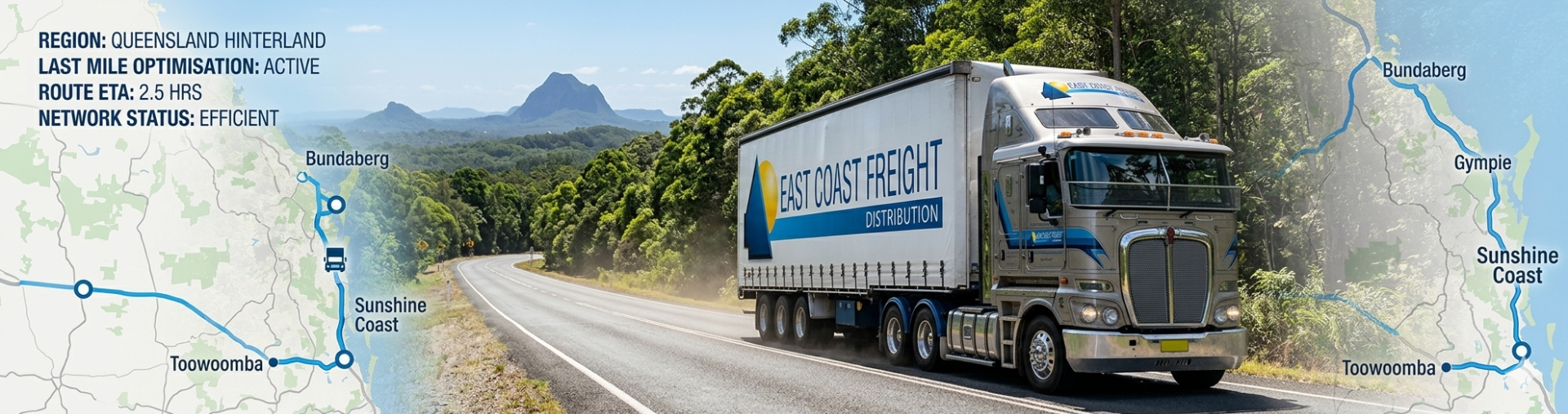
The Rise of Last-Mile Efficiency in Regional Queensland
For years, the freight conversation in Australia has centred around the major capitals. Bigger warehouses. Bigger ports. Bigger infrastructure projects. But on the ground here in Southeast Queensland, I’ve watched something else happen — regional areas are growing rapidly, and businesses can no longer afford to treat regional delivery as an afterthought.
From the Sunshine Coast to Gympie, Toowoomba, Bundaberg and the hinterland communities in between, customers expect the same speed, visibility and reliability they would receive in Brisbane, Sydney or Melbourne. The challenge is that regional logistics is an entirely different game.
At East Coast Freight Distribution, we’ve built our business around understanding that difference.
The rise of “last mile” efficiency is changing the way businesses think about freight, customer service and growth across regional Queensland. And in many ways, the businesses that master regional delivery will have a significant competitive advantage over those still relying on metro-focused freight models.
Regional Queensland Is No Longer “Secondary”
One of the biggest shifts we’ve seen over the past few years is the movement of people and businesses away from major city centres.
The Sunshine Coast and surrounds have experienced enormous growth. Businesses are opening distribution points outside Brisbane. Trades are servicing wider areas. Retailers are expanding regional operations. Online shopping has exploded across regional communities.
But growth creates pressure.
Customers in regional areas no longer accept extended delivery windows simply because they live outside a capital city. They want fast turnaround times, real-time tracking and dependable service. Businesses that can deliver consistently into these areas gain trust quickly.
The problem is that regional freight isn’t as simple as putting more trucks on the road.
Queensland’s geography creates unique operational challenges. Routes are longer. Delivery points are more dispersed. Weather conditions can change quickly. Road networks vary dramatically between urban and hinterland areas. Fuel costs become a larger factor. Scheduling becomes tighter. One delay can impact an entire delivery chain.
That’s where specialised regional distribution networks become critical.
The Real Cost of Inefficient Last-Mile Delivery
A lot of businesses still focus purely on freight cost per pallet or per shipment, but in reality, the bigger cost often comes from inefficiency.
- Late deliveries damage customer trust.
- Poor communication creates frustration.
- Missed delivery windows affect staffing, scheduling and operations for the receiving business.
When freight providers don’t understand regional delivery conditions, small problems quickly become expensive ones. I’ve seen businesses lose customers simply because they couldn’t provide reliable delivery visibility outside metro areas. I’ve also seen businesses grow rapidly because they invested early in dependable regional freight partnerships.
Last-mile delivery is no longer just an operational function. It has become part of the customer experience. That’s especially true in industries where timing matters — construction, retail, manufacturing, medical supplies, hospitality and trade services. Businesses want confidence that goods will arrive where they need to be, when they need to be there.
Speed vs Cost: The Balancing Act
One of the biggest misconceptions in logistics is that faster always means better. The reality is more nuanced.
Every business must balance speed, service and cost. In regional freight, that balancing act becomes even more important. Urgent deliveries can absolutely be critical in some situations. But constantly running reactive freight models creates inefficiencies that eventually increase operational costs for everyone.
The key is building smarter distribution networks.
At ECFD, we focus heavily on route optimisation, freight consolidation and strategic scheduling to improve efficiency without sacrificing service quality. Sometimes the smartest freight solution is not necessarily the fastest truck leaving the depot — it’s the most efficient movement across the broader network.
Technology plays a massive role in this.
Real-time tracking systems, route management software and delivery visibility tools now allow businesses to monitor freight movements with far greater accuracy than ever before. Customers expect updates. They want transparency. They want to know where their freight is and when it will arrive.
But technology alone isn’t enough. You still need people who understand the local terrain.
Why Local Knowledge Still Matters
This is something I don’t think gets talked about enough in logistics. You can have all the software and automation in the world, but regional freight still relies heavily on local operational knowledge.
- Knowing the roads.
- Knowing the delivery conditions.
- Knowing which areas become difficult during storms.
- Knowing seasonal traffic patterns across the Sunshine Coast and hinterland.
- Knowing how to navigate regional delivery points efficiently.
That local expertise is difficult to replicate from a capital city control room.
Our drivers and operations teams understand the realities of regional Queensland because we work in these areas every day. We understand the pressure businesses face when deliveries are delayed. We understand how important consistency is for regional operations. That knowledge becomes especially important in hinterland and semi-rural areas where delivery conditions can change quickly.
A GPS might show the shortest route. Local experience often shows the smartest one.
The Sunshine Coast Opportunity
The Sunshine Coast region continues to evolve into a major economic hub, and freight demand is growing with it.
We’re seeing increased activity across construction, retail distribution, manufacturing, food services and eCommerce. More businesses are looking to operate outside Brisbane while still maintaining strong supply chain performance. That creates enormous opportunity for businesses that can move goods efficiently across the region.
- But it also raises expectations.
- Customers expect faster fulfilment.
- Businesses expect better visibility.
- Operations teams expect reliability.
And freight providers are under increasing pressure to deliver all three simultaneously. That’s why regional logistics networks can no longer operate as an extension of metro systems. They need to be purpose-built for regional efficiency.
At ECFD, that has meant investing in operational processes, technology and local capability that supports consistent regional service delivery. Because ultimately, businesses don’t just need freight moved. They need certainty.
The Future of Regional Distribution
I believe regional Queensland will continue to become one of the most important freight growth corridors in Australia.
Population growth, infrastructure investment and business migration away from capital cities will only increase the demand for reliable regional logistics. The businesses that succeed in this environment will be the ones that treat logistics as a strategic advantage rather than a basic operational expense.
Last-mile efficiency is no longer just about getting freight from point A to point B.
- It’s about customer retention.
- Brand reputation.
- Operational consistency.
- And long-term scalability.
For businesses operating across the Sunshine Coast and broader East Coast regions, having the right freight partner matters more than ever. Because in regional Queensland, local knowledge, reliability and network efficiency still make all the difference.