East Coast Freight Distribution

How to Deliver Freight Without a Loading Dock: Mobile Forklift Hire Explained
If you’ve ever turned up to a delivery site only to find there’s no loading dock, no forklift, and no way to safely move your freight, you already know the problem. It slows everything down, creates safety risks, and often forces businesses into expensive workarounds that weren’t planned for in the first place.
At East Coast Freight Distribution, we see this challenge often. Warehouses, retail sites, construction zones, regional depots, and even commercial premises are increasingly operating without fixed loading infrastructure. Yet freight still needs to move, pallets still need to be unloaded, and timeframes are still tight.
That’s where mobile forklift hire, combined with freight transport, changes the game completely. We’ve built our operation around solving exactly this problem: delivering freight to sites that aren’t equipped to receive it.
Why Traditional Freight Falls Short
Standard freight delivery models assume one thing: the destination has infrastructure. A loading dock, a forklift, or at the very least, staff and equipment capable of safely unloading pallets. But that assumption doesn’t always reflect reality.
On the Sunshine Coast, many new industrial estates are built without full freight infrastructure. In Brisbane, infill developments and tight-access commercial sites often prioritise space efficiency over logistics functionality. Add in regional builds, retail rollouts, and temporary sites, and you’ve got a consistent problem: freight arriving faster than the site can handle it. The result is delays, handballing between contractors, or in some cases, failed deliveries and rebooking costs.
This is where mobile forklift hire paired with freight delivery becomes not just useful, but essential.
What Mobile Forklift Hire Actually Solves
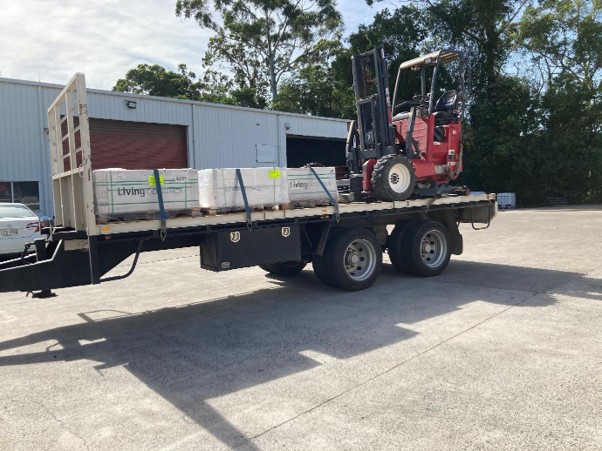
A truck-mounted forklift (often referred to as a Moffett forklift) is not just an add-on. It’s a fully integrated solution that travels with the freight.
Instead of relying on the receiving site to have lifting equipment, the forklift comes with the delivery vehicle. That means we can unload pallets, machinery, building materials, and bulky freight directly at the point of delivery, regardless of site setup.
This solves three critical issues:
- Access limitations. Narrow driveways, uneven ground, or construction sites with no formal loading areas are no longer a barrier.
- No on-site equipment required. You don’t need to coordinate forklifts, hire equipment separately, or depend on site availability.
- Faster turnaround. Freight is unloaded immediately on arrival, reducing wait times, labour costs, and delivery bottlenecks.
For businesses managing bulk freight transport in Brisbane or pallet delivery on the Sunshine Coast, this is a major operational advantage.
The Real Cost of Not Having Mobile Forklift Capability
It’s easy to underestimate the cost of inefficient unloading until you add it up. Every failed or delayed delivery has a ripple effect. Labour gets rescheduled. Projects stall. Inventory sits idle. Customers wait longer than expected.
In construction, a single delayed pallet of materials can halt an entire day’s workflow. In retail rollouts, missed delivery windows can push back store openings. In manufacturing, inbound freight delays can disrupt production schedules.
We’ve seen businesses try to solve this by sending staff to manually unload freight or hiring forklifts locally at short notice. Both options are reactive, inconsistent, and often more expensive than planned logistics. Mobile forklift hire removes that uncertainty by making unloading capability part of the delivery itself.
How the Combined System Works
At East Coast Freight Distribution, we’ve structured our service to remove friction from end to end. It starts with freight collection. Pallets or bulk freight are picked up from the supplier or warehouse as normal. From there, the freight is transported using vehicles equipped with truck-mounted forklifts.
On arrival at the destination, the driver operates the forklift directly from the truck. There’s no waiting for site staff, no subcontracting equipment, and no dependency on external coordination. The freight is placed exactly where it needs to go, safely and efficiently.
This integrated approach is particularly effective for
- Sunshine Coast pallet delivery where many sites are semi-rural, newly developed, or limited in infrastructure
- Brisbane bulk freight transport where access constraints and time pressures are common
- Regional and coastal sites where traditional logistics support is limited or inconsistent
Why This Model Is Growing Rapidly
The demand for mobile forklift hire is increasing because the way businesses operate has changed. Sites are more temporary. Build cycles are faster. Warehousing strategies are leaner. And many businesses are avoiding heavy infrastructure investment in favour of flexibility.
At the same time, supply chains are under pressure to move faster with fewer delays and less manual handling.
Truck-mounted forklift delivery bridges that gap. It allows businesses to stay agile without sacrificing operational reliability. From our perspective, this isn’t just a niche service anymore. It’s becoming a core requirement for modern freight movement.
Reducing Risk in Freight Handling
One of the most overlooked benefits of mobile forklift integration is safety. Manual unloading or improvised handling methods increase the risk of product damage and workplace injury. Forklifts are designed for stability, load control, and precision. When they are built into the delivery process, handling is no longer improvised—it’s controlled.
This matters for compliance, insurance, and workplace safety obligations. It also protects the integrity of the freight itself, which is especially important for high-value or sensitive goods.
For businesses moving bulk freight or coordinating pallet delivery, reducing handling risk is not just a logistics benefit. It’s a business safeguard.
When You Should Be Using Mobile Forklift Delivery
If any of the following sound familiar, this model is likely already relevant to your operations:
- Your delivery sites don’t always have forklifts available
- You experience delays waiting for unloading
- You operate across multiple site types with varying access conditions
- You regularly move palletised or bulky freight
- You need predictable, time-sensitive deliveries without reliance on site infrastructure
In these cases, mobile forklift hire is not an upgrade. It’s a correction to a structural logistics gap.
Final Word
Freight doesn’t fail because it’s poorly packaged or incorrectly shipped. More often, it fails at the final point of delivery, where infrastructure assumptions don’t match reality. By combining freight transport with mobile forklift capability, we remove that final barrier.
At East Coast Freight Distribution, our focus is simple: get freight from A to B, and safely off the truck, regardless of what’s waiting at the destination.
For businesses dealing with pallet delivery on the Sunshine Coast or bulk freight transport in Brisbane, that reliability is what keeps operations moving. No docks. No delays. No dependence on site infrastructure. Just freight delivered and handled properly, every time.